Frequency-Based Trip Expansion
frequencies.txt declares that a "template" trip (one that already has a full
row-per-stop pattern in stop_times.txt) actually repeats every headway_secs
seconds between start_time and end_time, rather than running just once.
pyGTFSHandler expands this into concrete, individually addressable departures.
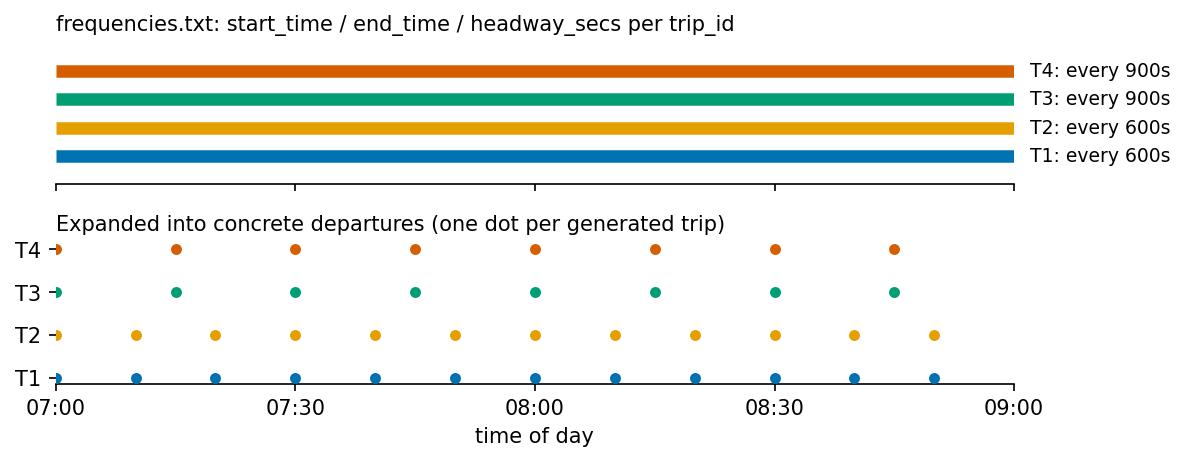
Feed.filter's frequencies flag
Feed.filter(..., frequencies=...) is the keep-as-template switch, not
an "expand" switch: frequencies=True (the default) leaves
frequencies.txt-defined trips as unexpanded templates, and
frequencies=False is what calls _frequencies_to_stop_times and
produces the concrete per-departure rows shown above.
1. Reading and window reconciliation
_read_frequencies parses start_time/end_time into seconds-since-midnight
(supporting values ≥ 24:00:00 for windows that run past midnight) and tags
every row with its orig_trip_id.
Because a single trip can have several frequencies.txt windows covering
different parts of the day, _reconcile_frequency_windows walks each trip's
chain of windows (sorted by start_time) and aligns adjacent windows onto a
clean grid:
- If a window's
(end_time - start_time)is already an exact multiple of its ownheadway_secs, it is left untouched. - Otherwise
end_timeis pushed up to the next exact multiple:
- If that push moves
end_time'past the next window'sstart_time, the next window'sstart_timeis pulled forward to match (and, ifend_time'reaches or passes the next window's ownend_time, that next window collapses entirely) — so a trip's full day of frequency windows always tiles with no overlaps and no dangling, unreachable trailing period.
Windows whose time range crosses midnight are first split into two separate
per-day trip_id chains before this reconciliation runs, so no single chain
handled by _reconcile_frequency_windows itself crosses midnight.
2. Aligning departures to the stop template's own timing
Each frequencies.txt row is matched against its trip's stop_times.txt
template, which already has a departure_time for the first stop and a
shape_time_traveled offset (elapsed time since the first stop) for every
other stop.
Feed._frequencies_to_stop_times generates concrete departures by first
aligning the requested window start to the template trip's own first-stop
departure time, so generated instances land on a clean grid that includes the
template's original timing rather than an arbitrary multiple of start_time:
Then, for every stop of the template, new departure times are generated on the regular grid
i.e. pl.int_ranges(aligned_start, end_time + shape_time_traveled,
headway_secs), one range per (trip, stop) row, then exploded into one row per
generated departure.
3. New trip IDs and arrival/departure shift
Each generated instance gets its own synthetic trip_id:
where k = ceil((new_departure_time - start_time - shape_time_traveled) / headway_secs)
identifies which repetition of the template this row is. The stop's
arrival_time is shifted by the same delta as departure_time so the
template's original dwell time (arrival_time - departure_time at that stop)
is preserved:
Rows whose start_time is null (i.e. trips that were never referenced by
frequencies.txt) pass through this step unchanged, with new_departure_time
simply set to the existing departure_time. After expansion, every row gets
n_trips = 1 (one physical departure) and start_time/end_time/
headway_secs are cleared, since those columns no longer apply once a
concrete departure time exists.
Interaction with midnight crossing
The window-splitting step in section 1 and the day_offset handling described
in Calendar handling work together: a frequencies.txt window
that spans midnight is split at the day boundary into two chains before
expansion, and each expanded departure inherits the correct day_offset from
its half of the split — so a service starting at 23:00 with a 30-minute
headway through 02:00 the next day produces departures correctly attributed to
either the original service date or the following one.