Calendar Handling
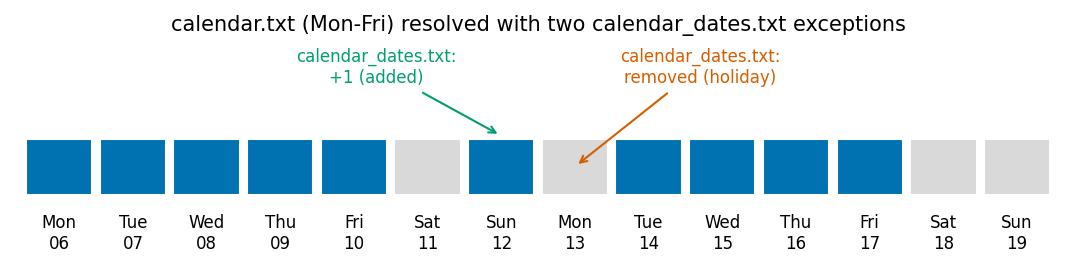
GTFS defines two, potentially overlapping, sources of truth for "is service
X running on date D":
calendar.txt— a weekday pattern (monday…sunday) valid within[start_date, end_date].calendar_dates.txt— single-date exceptions, either adding (exception_type=1) or removing (exception_type=2) aservice_idon one specific date.
pyGTFSHandler keeps both files exactly as authored — dates are converted to
integer days-since-epoch, but rows are never duplicated or date-shifted to
approximate overnight service.
Overnight/multi-day trips are instead handled entirely through
stop_times.txt's day_offset column (models/stop_times.py): a
stop_time's real calendar date is
resolved at query time by Feed.filter_by_date/filter_by_date_range, which
check, for each distinct day_offset value present, whether the service is
active on queried_date - day_offset. Calendar itself has no awareness of
day_offset — it only ever answers "which service_ids are active on date
X".
Resolving active services for a single date
Calendar.get_services_in_date(date):
- From
calendar.txt: services whereweekday(date) == 1andstart_date ≤ date ≤ end_date. - From
calendar_dates.txt: services withexception_type=2ondateare removed; services withexception_type=1ondateare added. - Final result:
Resolving active services over a date range
Calendar.get_services_in_date_range(start_date, end_date, date_type=None, lon=None, lat=None)
does the same resolution independently for every date in
[start_date, end_date], returning one row per date with the sorted list of
active service_ids (date, weekday, service_ids).
Feed's constructor calls this with the requested window widened by one day
at the start (start_date - timedelta(days=1)) specifically so that services
whose last stop_time falls after midnight on the day before start_date
(i.e. day_offset=1 relative to that prior date) are still picked up.
Date-type classification (weekday/weekend/holiday/...)
Calendar.filter_by_date_type(result, date_type, lon, lat) filters the
per-date service_ids table down to dates matching one or more of:
workday/businessday, holiday, non_workday/non_businessday, weekday,
weekend/non_weekday, or a specific weekday name. Multiple date_type
values are combined with AND semantics.
weekendis computed purely from the weekday name — no network access.holiday(and anything derived from it —workday,non_workday, ...) additionally callsCalendar.add_holidays_and_weekends, which:- Resolves a country/subdivision from
(lat, lon)viautils.geocoding.get_country_region(the mean stop coordinate of the loaded feed, computed once inStops.load). - Fetches a holiday calendar per distinct year present in the data
(
utils.date_parsing.get_holidays). - Flags each date as
holidayif it appears in that calendar.
This split matters because Feed reuses filter_by_date_type to classify a
stop_time's offset-adjusted real date (not its nominal service_date) — a
trip departing at 25:30 on a Friday's service_id might really run into
Saturday, and should be classified as a weekend departure if date_type
requests one, which is exactly what threading the resolved real date back
through this same function achieves.
Mutating calendar bounds
Feed.calendar_new_start_date/calendar_new_end_date overwrite
start_date/end_date directly on the loaded calendar.txt LazyFrame — for
one source file (file_id), one named feed (gtfs_name), or globally — used
when combining/aligning several historical GTFS snapshots without re-reading
from disk.